


The report “The European Midcap Investment Opportunity”, presented by INBONIS Rating at a CEPS-ECMI seminar, identifies some 5,350 European midcaps with a potential investment-grade profile and a €1.26 trillion long-term debt gap relative to their US counterparts

Brussels, 24 November 2026 – Rating Europe’s midcaps could retain €124 billion a year of European savings by 2029, through long-term debt and equity, and €1.5 trillion by 2035. These are some of the findings of the first report of INBONIS Rating’s European Midcap Observatory, “When Midcaps Meet Intangibles: The European Investment Midcap Opportunity”, presented at a CEPS-ECMI seminar in Brussels.
The report analyses 25,631 European midcaps, companies employing between 250 and 2,999 people, and compares them with their US counterparts in the same activities. It organises the economy into eight final value chains that account for 68% of EU value added and that trace production through to the final demand it serves, encompassing agri-food, textiles and pharma, household goods and electronics, automotive, tourism, housing and energy, transport and finance, and health and care. Based on their specialisation in them, member states are grouped into four Europes: Central Europe, the EU’s industrial and manufacturing core; North Atlantic Europe, specialising in knowledge-intensive activities; Mediterranean Europe, more oriented towards services, tourism and final consumers; and Emerging Europe, where companies are converging from lower productivity levels.
The report comes at a time when an increasing share of Europe’s capital is invested in the United States rather than financing productive investment at home. Euro-area holdings of US assets rose from 27% of GDP in 2000 to 77% in 2025, while the gap in returns on capital between the United States and the EU widened from 1.7 to 4.5 percentage points. The report concludes that productive midcaps could retain some of these capital outflows.
Productive companies that struggle to scale up
Europe’s 25,631 midcaps, hold 2.4 times as much intangible capital per worker as smaller companies and achieve 86% of the labour productivity of their US counterparts. Yet firm-size distributions suggest that European midcaps are less likely to grow beyond around 500 employees.
Financing structures reinforce this constraint. Long-term loans and bonds account for just 18% of European midcaps’ total assets, compared with 28% in the United States, and access to bond markets remains concentrated in larger companies: only 1.5% of firms with 250 to 499 employees that used external financing to invest issued bonds, against 19% of firms with 3,000 or more employees. The result is a potential scaling trap: midcaps need long-term financing to grow, but often lack the size and visibility required to obtain it.
“Europe cannot retain its savings simply by encouraging investors to keep their capital at home”, says Víctor Ausín, Chief Economist at INBONIS Rating and author of the report. “It must make European companies more visible, financeable and capable of generating competitive returns. European midcaps represent a substantial opportunity to achieve this.”
European midcaps can produce similar returns as their US counterparts.
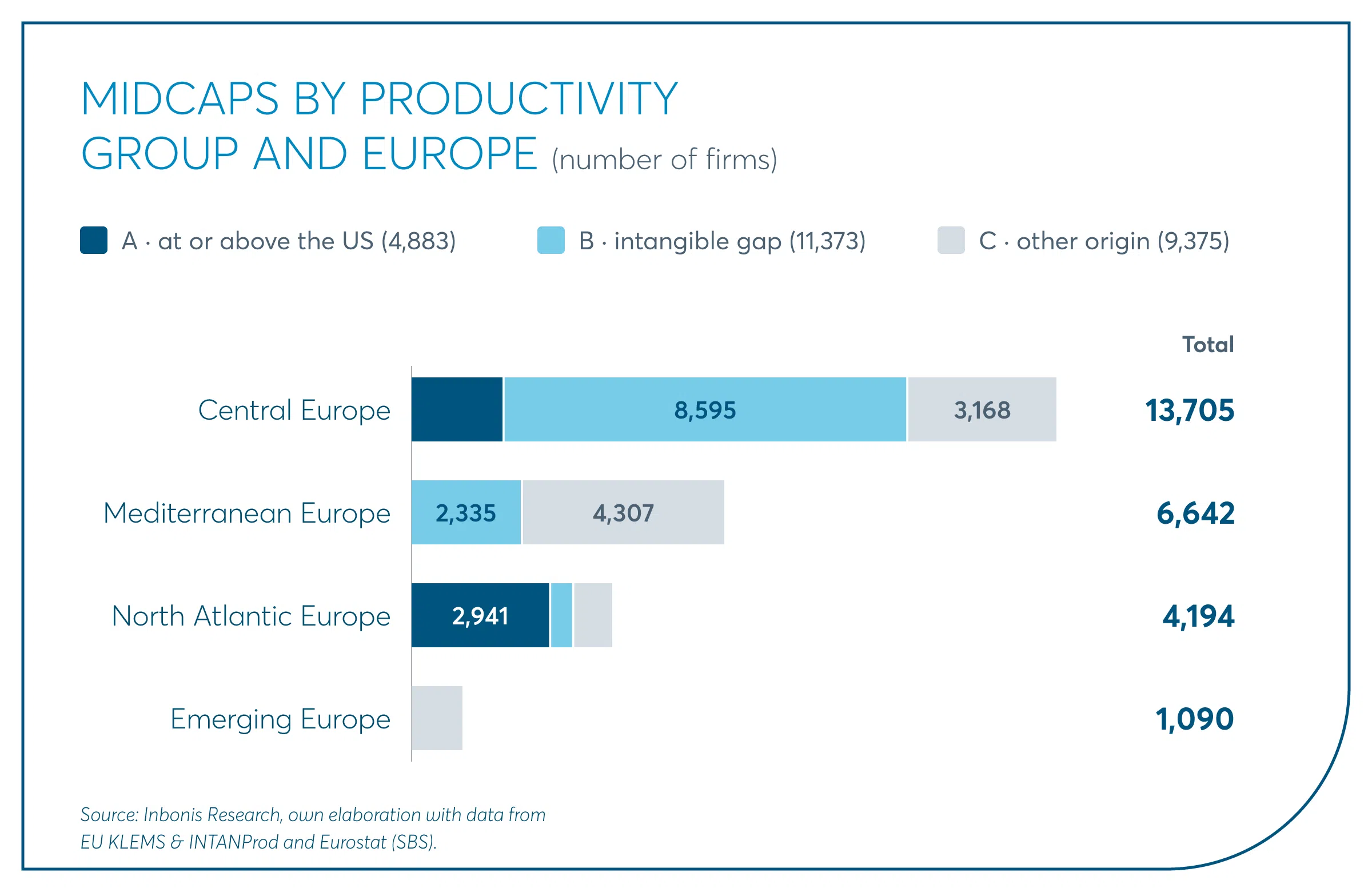
Each midcap is compared with US peers in the same Europe and value chain, and classified into one of three groups according to the origin of its productivity gap. The origin of the gap determines the financing instrument each group needs to keep growing.
Some 5,430 high-productivity midcaps (Group A) already match or exceed the productivity of their US peers and what they need are longer maturities, through long-term loans and bonds. The largest group, Group B, around 12,070 companies, lags behind mainly for lack of intangible capital, and would need bonds, equity and credit secured on intangible assets. The remaining 8,130 (Group C) trail for other reasons, such as technology diffusion or specialisation, and bank loans are the main instrument.
The needs vary significantly across regions, with two-thirds of Central European midcaps belonging to the group held back by intangible investment, while four in five North Atlantic midcaps already match US productivity. Closing the gap will therefore require a different financing mix in each part of Europe.
Ratings as a gateway to financing
The report estimates that some 5,350 European midcaps have a potential investment-grade credit profile but lack sufficient visibility in capital markets. Independent credit ratings could help banks and institutional investors assess and compare their creditworthiness, enabling greater access to long-term lending, corporate bonds and cross-border financing.
In the report’s central scenario, rating these 5,350 midcaps between 2027 and 2029 would retain €124 billion a year in Europe in 2029, €34 billion of it as long-term debt and the rest as equity. Extending ratings to the rest of the eligible midcaps, some 16,200 in all, by 2035 would reach, from 2032, the €229 billion annual ceiling estimated for midcaps and large firms. By 2035, retained funds would total €1.5 trillion, midcaps would have closed 43% of their intangible-capital gap and 22% of their labour-productivity gap with the United States, and EU productivity would be 1.4% above a baseline without ratings.
Destination matters more than volume: in the report’s simulations, each €100 billion directed at the intangible investment of the midcaps that need it most adds 0.14 points of EU productivity, against 0.01 for general debt.
“Europe has thousands of midcaps with an investment-grade profile that investors simply cannot see”, adds Alberto Sánchez Navalpotro, CEO of INBONIS Rating. “Making them visible through verified information is the fastest way to keep European savings in Europe and to increase cross-border bank lending. That is why we have decided to walk the talk and launched a programme of unsolicited ratings covering 2,000 of these companies, which will be completed in 2027–2028.”
INBONIS is the pioneering rating agency in the credit rating of SMEs and midcaps in Europe. Since its registration with the European Securities and Markets Authority (ESMA) in 2019, it has issued more than 1,800 corporate ratings across 12 countries of the European Union. It is recognised by the Eurosystem as an External Credit Assessment Institution (ECAI).
INBONIS’s mission is to democratise credit ratings to give SME and midcaps access to better long-term financing, increase their credibility with business partners and serve as a tool for financial education. In doing so, INBONIS aims to help drive the growth and competitiveness of companies.
About the European Midcap Observatory
The European Midcap Observatory (EMO) is an INBONIS Rating initiative designed to make European midcaps and their investment potential more visible to investors and policymakers, helping channel European savings towards productive investment.
INBONIS is a certified B Corp, part of the community of companies competing to be the best for the world.

INBONIS Rating
INBONIS Rating is the first credit rating agency specialising in SMEs and mid-caps registered and supervised by the European Securities and Markets Authority (ESMA). In Europe, only rating agencies accredited by ESMA can issue ratings. This accreditation allows the agency to issue rating notes on SMEs and mid-caps in any sector within the European Union.